Funding an MVP in Luxembourg: Fit 4 Start and More
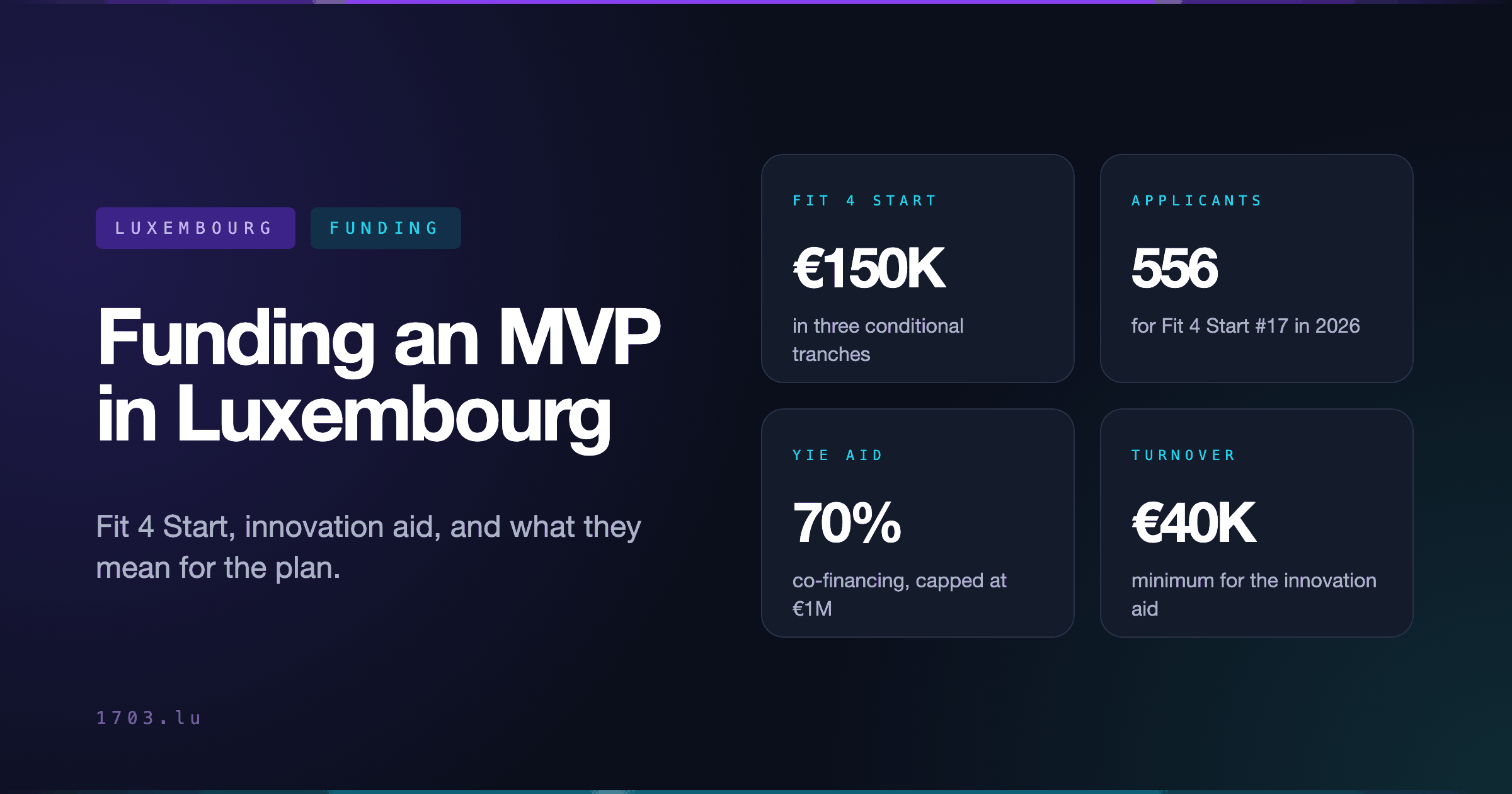
This summer 556 startups applied to Fit 4 Start, Luxembourg's public accelerator. 24 of them went through to the next round of the 17th edition. That's about one in twenty-three.
If you're building a startup here, you've probably looked at it, and at the other public money on offer. I've read the official rules for the two schemes founders ask me about most, and this post is what I'd want to know before planning an MVP around them.
Two things first. I'm not a funding advisor, and these rules change between editions. Treat this as a map and check the current version on guichet.lu and with Luxinnovation before you count on any number. And I build MVPs for a living, so my angle is how the money shapes the product plan.
Short version: Fit 4 Start pays up to €150,000 in three conditional tranches. The young innovative enterprise aid co-finances up to 70% of a larger project, but only for companies that already have revenue and private money. Neither pays for a product all at once, so plan releases that produce evidence at each step.
Fit 4 Start
Fit 4 Start is run by Luxinnovation for the Ministry of the Economy. Per the official guichet.lu page (last updated January 2026):
- Up to €150,000 of subsidy, paid in three instalments of €50,000, €80,000 and €20,000. Each one is "subject to various conditions".
- Six months of coaching, with a free co-working desk for the same six months.
- You don't need a company when you apply. If you already have one, it can't be older than five years when the call opens, and it has to be a small enterprise.
- At least two people on the team, one of them full time, everyone 18 or over. For-profit projects only.
Luxinnovation describes the same money a bit differently in their news on edition 17: €50,000 on incorporation in Luxembourg, and up to €100,000 more for startups that raise funds and employ at least two people. Same total. The conditions behind the later money are the part to read carefully.
The edition 17 calendar
For a sense of timing, here's how the current edition runs, from the same Luxinnovation post:
| Step | Date |
| Call opens | 11 June 2026 |
| Call closes | 10 July 2026 |
| Pitches at Luxembourg Venture Days | 14 and 15 October 2026 |
| Final selection | October 2026 |
| Six months of support start | January 2027 |
The 24 startups in that round split into digital (10), health technologies (5), space (5) and defence (4). Defence is a new vertical this year.
So from application to the start of coaching is about six months. If your plan is "apply, get the money, then build the MVP", that's half a year of waiting first.
Aid for young innovative enterprises
This is the bigger scheme, for companies a bit further along. From the guichet.lu page (last updated June 2025):
- Up to 70% of the financing need, over three years at most, capped at €1 million per company.
- Private financing has to come on top. You must show it.
- The company is under five years old, not listed, and small.
- It made at least €40,000 in turnover in the last financial year or the last 12 months.
- It has an innovation certificate from Luxinnovation. One of the tests: R&D was at least 15% of total operating expenses in one of the three previous years.
- The money is paid after the project, with up to 70% in two instalments along the way.
One warning: the Startup Luxembourg overview still describes this aid as matching private investment up to €800K. The guichet.lu page is the official one and the more recent, so I'd go by €1 million, and confirm it when you apply.
The same overview lists other options too: Luxinnovation's R&D and innovation subsidies, the Digital Tech Fund, SNCI and more. Worth a read once you know which stage you're at.
What this means for your MVP plan
Here's the part I actually know something about.
The money comes in steps, so should the product
Neither scheme hands you a lump sum for "build the app". Fit 4 Start pays in tranches with conditions. The innovation aid pays mostly after the work, with part of it along the way. That fits a lean MVP well, if you plan for it. Each release should produce something you can show: real users, a number that moved, a decision you made because of it.
What doesn't fit is a twelve-month build with one big launch at the end. You'd be spending the later tranches before you have the evidence that unlocks them.
Revenue is a requirement, not a bonus
The innovation aid asks for at least €40,000 in turnover. So at some point your MVP has to charge money. I'd put pricing into the first release, even if it's one plan and a payment link. A paid user tells you more than a hundred free sign-ups, and you need the revenue later anyway.
Keep records from day one
The 15% R&D test and the reporting on any grant are easier when the work is documented as you go: what was built, when, by whom, and why. A shared repository with a clean history and a short note per release covers most of it. It also makes due diligence shorter when you raise.
Own your code
If a freelancer or agency builds the MVP, make sure the code sits in your repository from the first commit. Investors will ask, and a grant-funded product that you don't fully own is an awkward conversation.
Don't spend the first tranche on the whole build
€50,000 sounds like a lot until you price a full product. Spend it on the smallest thing that tests your riskiest assumption, and keep enough to react to what you learn. I wrote more on choosing that scope in the lean startup MVP guide.
The grant isn't the validation
One last thing, and it's the most important. Getting into Fit 4 Start says a jury liked your pitch. It's a good sign. It doesn't say customers will pay.
The point of the MVP is still the same: put something in front of real users and see what they do. The public money buys you time to do that properly. It doesn't replace it.
Want help with the plan?
We're a small team in Bertrange that builds MVPs in Elixir: a scoping workshop first, then a fixed price for the first release, planned around your milestones. We can't tell you whether a cost is eligible, that's for Luxinnovation and the Ministry, but we can make sure the product side of the plan holds up.