Lean Startup MVP: What to Build First
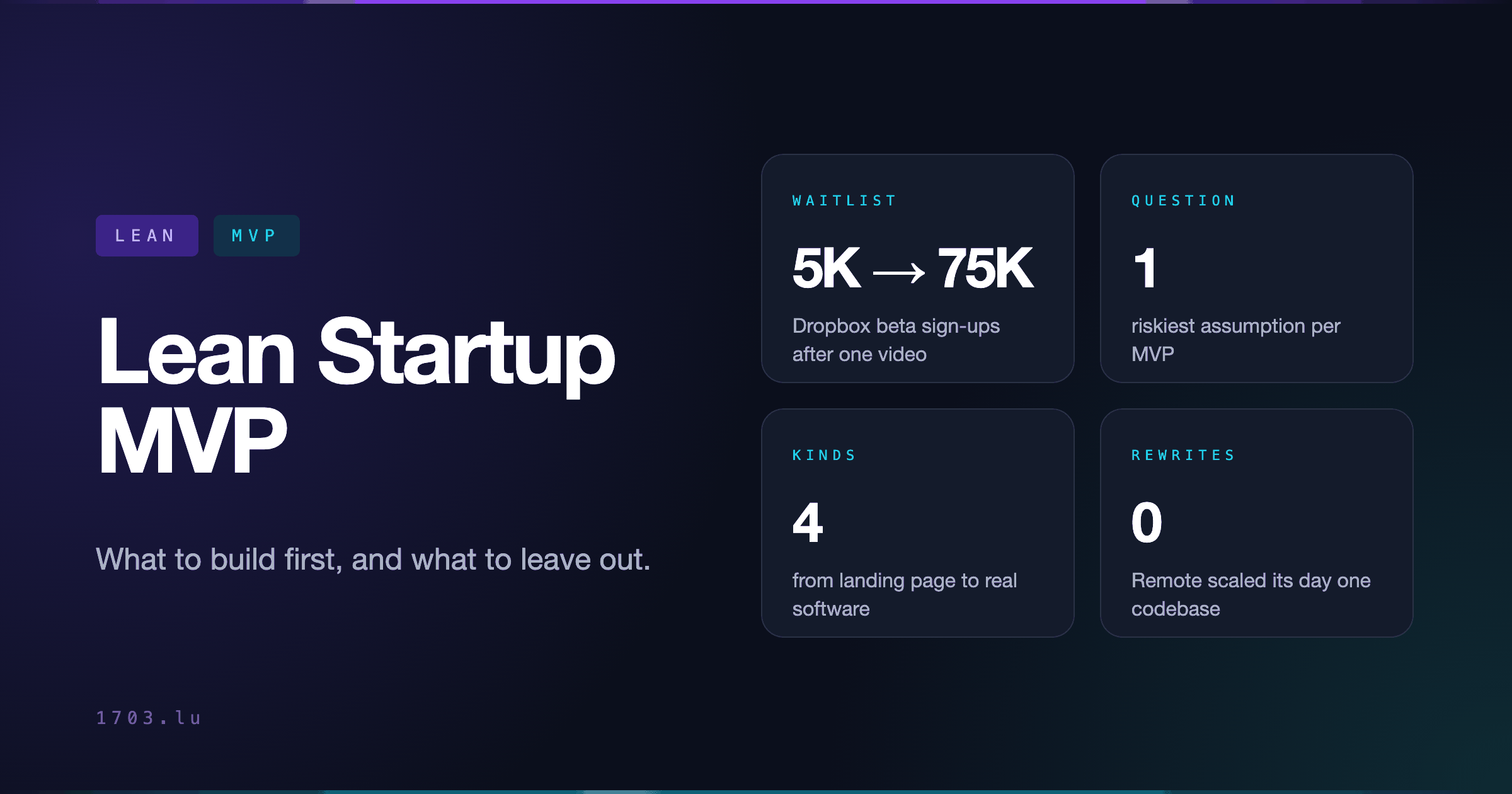
Early Dropbox was hard to show. File sync that works in the background is boring in a prototype, and building it well for every operating system takes years. So Drew Houston made a video. Eric Ries tells the story in his guest post on TechCrunch, and the line I remember is the result: the beta waiting list went from 5,000 people to 75,000 overnight.
A video answered the question that mattered before the years of building: do people want this?
That's what an MVP is for. I build software for a living, so it's a bit odd for me to start with an example where the answer was "don't write code yet". But most of the MVPs I've seen go wrong went wrong in the same place: too much product, too little learning.
Short version: an MVP isn't a small version of your product. It's the cheapest experiment that tests your riskiest assumption with real users. Sometimes that's a landing page, sometimes it's you doing the work by hand, and sometimes it really is software. Then you build it in something you won't have to throw away.
What "minimum viable product" actually means
The term comes from the Lean Startup movement. Ries defines the MVP as the "version of a new product which allows a team to collect the maximum amount of validated learning about customers with the least effort". His book, The Lean Startup, came out in September 2011, and the idea has been stretched in every direction since.
Read the definition again. It doesn't say "fewest features". It says most learning for least effort. The product is a tool for the experiment, not the goal.
The Agile Alliance puts the usual mistake in one sentence in their glossary: "Teams stress the minimum part of MVP to the exclusion of the viable part." You ship something so broken that nobody uses it, and then you can't tell if the idea is bad or the product is.
So there are two ways to fail. Build too much and you burn a year before you learn anything. Build something unusable and you learn the wrong thing.
Build, measure, learn
Lean Startup describes the work as a loop: ideas, build, product, measure, data, learn, and around again. The speed of the loop is what counts, not the size of each step.
In practice I'd turn it around and plan it backwards:
- Learn: What do you need to know? Write it as one sentence. "Accountants at small firms will pay €50 a month to stop retyping bank statements."
- Measure: What number would tell you? Sign-ups, paid accounts, how many statements people actually upload in week two.
- Build: What's the smallest thing that produces that number with real people?
If you can't write the first sentence, you're not ready to build. Go talk to customers.
Four kinds of MVP
You don't always need software. Here are the forms I see most, from cheapest to most expensive.
The landing page
A page that describes the product and asks for an email, a pre-order or a demo booking. The Agile Alliance notes an MVP can be no more than that. It tests whether the message makes people act. It doesn't test whether the product works.
The video or demo
The Dropbox route. Good when the product is hard to explain and expensive to build. You show the promise and count who raises a hand.
The manual service
You do the work by hand behind a simple form. Customers get the result, you get to see every step of the problem, and you learn what to automate. It doesn't scale, and that's fine. It's not supposed to.
The single-feature product
Real software, one job, done well. This is the right MVP when the thing you need to test only exists in the product itself: the speed, the live updates, the way it fits into someone's day. Nobody can judge a real-time dashboard from a screenshot.
How to decide what goes in
Here is the process we use with founders. It fits on one page.
- Write the riskiest assumption. Not the feature list. The one belief that kills the company if it's wrong.
- Pick the metric. One number, measured on real users, with a target you agree on before launch.
- List every feature you want. All of them. Get it out of your head.
- Cross out everything that doesn't move the metric. Admin panels, settings pages, dark mode, the second user role. They go on a later list, not in the bin.
- Check it's still viable. Can a real user get the job done without you on a call? If not, add back the minimum that makes it work.
- Set a date. If the scope doesn't fit the date, cut scope, not quality.
Step 4 is where it hurts. Every feature on that list has a story behind it, usually a customer who asked for it once. Cross it out anyway.
The prototype trap
Here's where I get biased, so keep that in mind.
A lot of MVPs are built to be thrown away. Quick no-code tool, or whatever stack the first freelancer knew, "and we'll rebuild properly when we raise". Then the round comes, the product has paying users, and the rebuild competes with every feature those users want. In my experience the rebuild usually loses, and the team spends the next years fighting the prototype.
I wrote about how good choices age badly before. The short lesson: the code you write for your first hundred users is often the code you'll still run at a hundred thousand.
That's why we build MVPs in Elixir and Phoenix. The interactive UI renders from the server, so one engineer takes a feature from the database to the screen without a separate frontend app. Background jobs, caching and live updates live in the same codebase. You start with an app and a database, and for a long time you don't need much more.
And it doesn't hit a wall later. Remote, the payroll company, used Elixir from day zero and became a unicorn in just over two years without leaving that codebase. Almost 180 engineers work in it today.
To be fair, if your MVP is a landing page or a manual service, the stack doesn't matter at all. Use whatever gets it live this week. The stack question starts when you write real product code.
When not to build an MVP yet
Some honest cases where I'd tell a founder to wait:
- You can't name the customer. "SMEs" is not a customer. "Office managers at 10 to 50 person firms in Luxembourg" is.
- Nobody has paid for anything close to it, not even a manual version.
- The risk is regulation or a partnership, not the product. A licence or a bank agreement won't come faster because you have an app.
- The plan is to show it to investors, not users. Investors want traction, and traction comes from users.
Checklist
- One sentence: what you need to learn.
- One number: how you'll know.
- One page: the scope, with everything else on a "later" list.
- A date, and a rule that scope moves before the date does.
- Real users in production, not a demo environment.
- Analytics in place on day one.
- A stack you won't have to throw away if it works.
- A decision meeting after launch: continue, change direction, or stop.
Building in Luxembourg?
If you're applying to Fit 4 Start or another public programme, the money comes in tranches with conditions, so the MVP plan matters even more. I wrote a separate post on funding an MVP in Luxembourg.
And if you want help scoping or building it, that's what we do from Bertrange. We start with a scoping workshop and a fixed price for the first release, and we'll tell you if the right first step is no code at all.